


 Best seller
 Trending












Hashtack Journalaccessories guide
How to Match a Chain Design to a Pendant: A Complete Pairing Guide
In this article17
Cable, box, snake or curb? Here's how to match any pendant to the right chain by weight, length, shape and colour, with a size chart and layering rules.
Updated 18 November 2026 · Written by the Hashtack team, Noida
To match a chain with a pendant, pair the chain's thickness to the pendant's weight, its style to the pendant's shape, its length to your neckline, and its colour to the pendant's metal, and make sure the pendant's loop (the bail) slides over the chain and its clasp. Get those five things right and almost any pendant looks like it was made for its chain. Get one wrong and even an expensive pendant looks off.
This guide covers chain types, a length chart in inches and centimetres, thickness rules, how to layer pendants, and the questions people actually type into Google. Every necklace we mention is shown with its photo and price, so you can see each pairing for yourself.

What's in this guide
- The short version
- Why does the chain matter?
- Which chain looks best with pendants?
- Chain thickness and pendant weight
- Pendant chain length chart
- Matching by pendant shape
- Matching metal and colour
- Can a pendant go on any chain?
- How to layer chains with pendants
- Best chain for a heavy pendant
- FAQs
The Short Version: How to Match a Chain With a Pendant
Matching a chain to a pendant comes down to balance. A small, light pendant needs a fine chain so the pendant stays the star. A large or heavy pendant needs a sturdier chain that can carry the weight without kinking, twisting or snapping.
Start with weight. Pick up the pendant. If it feels like almost nothing, a fine cable or ball chain is right. If you notice it in your palm, step up to a box, curb, rope or wheat chain, which hold their shape under load.
Then check length. Most jewellery sizing charts, including those from Blue Nile and Abelini, describe 17 to 18 inches (about 43 to 46 cm) as the classic pendant length, sitting at or just below the collarbone. Go shorter for dainty pendants worn high, longer for bigger pendants and high necklines.
Match style next. Smooth chains like snake and box suit clean, modern pendants. Textured chains like rope and curb suit bolder, vintage-feel pendants. Beaded and shell strands suit boho pendants.
Layering two pendants? Keep the chains about 2 inches apart, put the smaller pendant on the shorter chain, and make the chains different in texture so they don't knot together. And for a heavy pendant, skip fine cable and ball chains completely; they stretch, and the clasp ends up carrying the strain until something gives.
Keep the metal colour the same unless you're mixing on purpose. Gold-tone pendants on gold-tone chains look finished. Mixed metals work when you repeat both colours somewhere else in the look.
Finally, check fit. The pendant's bail must slide over the chain, and usually over the clasp too. That's the step people forget, and it's why a pendant sometimes won't go on a chain at all.
The easiest shortcut? Buy pendants already paired with their chain. Every Hashtack pendant necklace is sold as a complete necklace, already on its chain, from ₹199 to ₹1,499.
Why Does the Chain Matter as Much as the Pendant?
The chain controls where the pendant sits, how it hangs and how long it lasts. A beautiful pendant on the wrong chain flips backwards, slides to one side, or pulls the chain into a V that looks strained.
Think of the chain as the frame and the pendant as the picture. Too heavy a frame overwhelms a small picture. Too flimsy a frame can't hold a big one. Nobody notices a good frame, which is the point.
The classic mistake is a heavy charm on a hair-thin chain. It looks fine for a week. Then the links stretch, the clasp takes the strain, and the chain snaps at the weakest point. Choosing a chain that suits the pendant's weight is a durability decision as much as a style one.


Which Chain Looks Best With Pendants?
For most pendants, a cable chain or a box chain looks best, because both are simple, strong for their size and let the pendant take attention. Snake chains suit sleek modern pendants, rope and curb suit bold ones, and beaded strands suit boho ones.
Here are the chain types Google shows most often for this question, and when to use each:
| Chain type | What it looks like | Best pendant match | Watch out for |
|---|---|---|---|
| Cable | Simple oval or round links | Small to medium pendants, initials, solitaires | Very fine cable can stretch under heavy pendants |
| Box | Square links, smooth and sturdy | Medium pendants, geometric shapes | Kinks if bent sharply |
| Snake | Smooth, flexible tube | Sleek modern pendants, slides | Can't be untangled once kinked |
| Curb | Twisted links that lie flat | Coins, medallions, bolder pendants | Busy with intricate pendants |
| Rope | Twisted strands, like a rope | Vintage-style and heavier pendants | Competes with detailed designs |
| Wheat | Braid-like interlocking links | Heavier pendants that need support | Thicker look, less dainty |
| Ball / bead | Small metal beads on a line | Lightweight charms, casual pendants | Not for heavy pieces |
| Beaded or shell strand | Beads, pearls or shells strung together | Boho and coastal pendants | Not interchangeable with metal-chain pendants |
One opinion we'll stand by: for a first pendant, buy one on a fine, plain chain. Fancy chains are fun, but a simple chain works with the most necklines and layers with everything else you own.


What Chain Thickness Suits Your Pendant's Weight?
Light pendants suit fine chains; heavier pendants need thicker, tighter-linked chains. As a rule of thumb, the chain should look strong enough to hold the pendant without anyone thinking about it.
Chain width is usually listed in millimetres. You won't find one official standard, so we use this working guide in our own styling:
- Tiny charms and dainty pendants: the finest chains, roughly 1 mm or less.
- Everyday medium pendants: around 1 to 2 mm.
- Coins, medallions and larger pendants: around 2 to 3 mm or more, in a sturdier style like curb, box or wheat.
These are our styling ranges, not a formal rule. The real test is visual and physical: hang the pendant and look. If the chain bends into a sharp V at the pendant, or the pendant twists to face backwards, the chain is too light.
A practical tip: pendants with a large bail look odd on very fine chains because the bail swings around. Match a big bail to a thicker chain.


What Chain Length Should a Pendant Sit At?
Most pendants sit best at 16 to 18 inches (about 40 to 46 cm), at or just above the collarbone. Larger pendants and higher necklines suit 20 to 24 inches. Here's the standard chart, cross-checked across several jewellers' sizing guides:
| Name | Inches | Centimetres (approx.) | Where it sits | Pendant pairing |
|---|---|---|---|---|
| Collar | 12–13 | 30–33 | Snug around the neck | Rarely used for pendants |
| Choker | 14–16 | 35–40 | Base of the neck | Tiny pendants, worn high |
| Princess | 17–19 | 43–48 | On the collarbone | The classic pendant length |
| Matinee | 20–24 | 50–60 | Between collarbone and bust | Bigger pendants, high necklines |
| Opera | 28–36 | 70–90 | At or below the bust | Long pendants, layering |
| Rope | 36+ | 90+ | Below the bust | Doubled or knotted styles |
Sources for these ranges include The Pearl Source, Blue Nile and Abelini. Note that the same chain sits differently on different bodies. As one sizing guide points out, a princess length on a taller person with a broader chest can look like a choker. Measure on yourself with a string before buying a separate chain.
A Hashtack tip: where a listing says adjustable, as with the Golden Aura Adjustable Brass Necklace, you can move the necklace up or down to suit the neckline you're wearing that day. Where it doesn't, check the length in the listing before you order.
How Do You Match a Chain to Your Pendant's Shape?
Match smooth shapes with smooth chains, detailed shapes with simple chains, and bold shapes with sturdier chains. The chain should support the pendant's mood, not compete with it.
Round, coin and medallion pendants
Medallions carry weight and presence. A slightly thicker chain with a flat link, like curb, keeps them facing forward. The Solstice Medallion Necklace pairs a gold-tone oval medallion with sunburst detail and a delicate gold-tone chain, a good example of letting a detailed pendant lead.


Floral and nature-inspired pendants
Flowers, leaves and daisies have soft, organic outlines. They look best on fine, flowing chains that move with them. Our Delicate Daisy Necklace and Shimmerleaf Dainty Necklace are both built on this idea.


Evil eye and symbolic pendants
Small symbols like the evil eye are usually worn daily and close to the neck. A fine chain at 16 to 18 inches keeps them visible above most necklines. Look at the Golden Evil Eye Necklace, Eye See You Necklace and the layered Watchful Charm Layered Necklace.


Pearl drop pendants
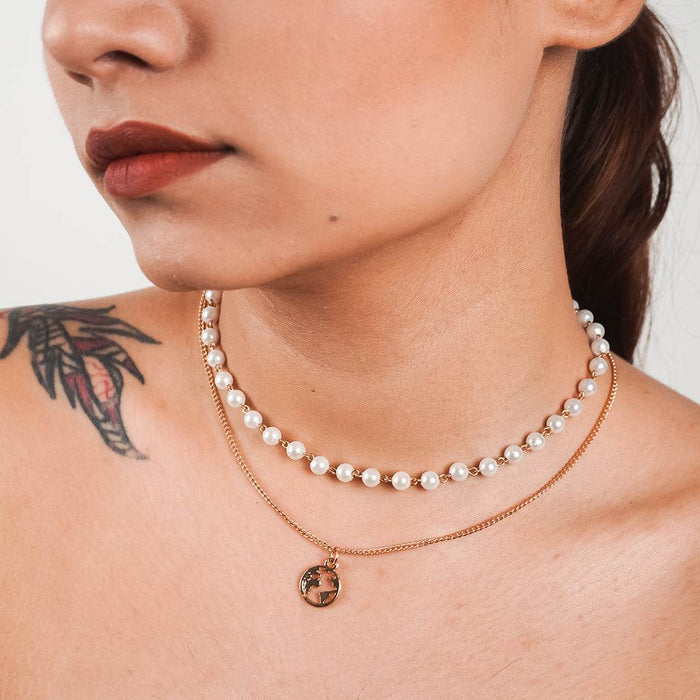
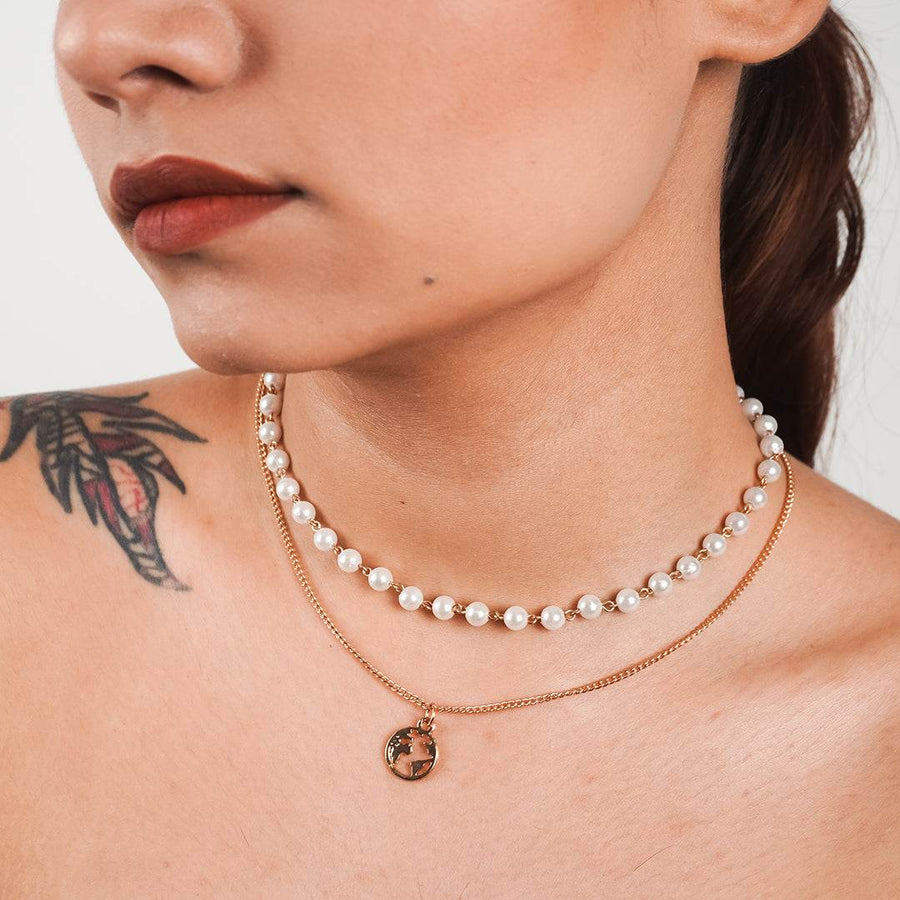
Pearls ask for simple chains. Fine gold-tone chains let the pearl's sheen do the work. Try the Pearl Drop Layered Necklace, Pearl Radiance Necklace or Twin Glow Pearl Necklace.


Shell, starfish and coastal pendants
Bigger, playful pendants need a strand with personality: beads, shells or a chunkier chain. The Ocean Sun Shell Pendant Necklace pairs an oversized ivory sun-shaped pendant with a handcrafted shell bead strand, which is the right call. A big sun on a thread-thin chain would look lost.


Gemstone-look pendants
Coloured stones draw the eye, so keep the chain plain. The Garnet Vesper Necklace and Blue Aura Necklace are good examples of a coloured focus on a simple chain.


Should Your Chain and Pendant Be the Same Metal Colour?
Usually yes. A gold-tone pendant on a gold-tone chain looks finished and intentional. Mixing silver and gold tones can look great too, but only when it's clearly on purpose.
If you mix, repeat both colours elsewhere: a silver-tone ring with your gold-tone chain, or a two-tone bracelet. That tells people it's a choice. And match finishes where you can. A high-shine pendant on a matte chain can look like two different pieces that met by accident.
If tarnish worries you, look at our anti-tarnish jewellery, which includes the steel Petal Theory Layered Necklace and brass pieces like the Solstice Chain Necklace.

Can a Pendant Go on Any Chain?
No. A pendant can only go on a chain that fits through its bail, and usually the clasp has to fit through too. Pendants that are soldered to their chain can't be moved at all.
Before you buy a separate chain, check three things:
- Bail opening. The loop at the top of the pendant must be wider than the chain and, ideally, the clasp.
- Clasp size. A lobster clasp is often wider than the chain itself. If it won't pass through the bail, the pendant won't go on.
- Attachment type. Some pendants are fixed with a jump ring or soldered in place. These are designed to stay on their original chain.
Google's autocomplete shows people searching "chain for pendant with small hole". If that's you, a fine cable or snake chain with a small spring-ring clasp is your best bet.
How Do I Connect a Pendant to a Chain?
Open the chain's clasp, slide the pendant's bail over the clasp end and along the chain, then close the clasp. If the bail is too small for the clasp, slide it over the other end, which usually has a smaller ring.
- Lay the chain flat and unfasten it.
- Check which end is narrower: the clasp or the end ring.
- Thread the pendant's bail over the narrower end.
- Slide the pendant to the middle of the chain.
- Fasten the clasp and hold the necklace up to check the pendant faces forward.
If neither end fits, a jeweller can add a bail converter or a larger jump ring. Don't force a closed bail open with pliers: on plated pieces, that's how finishes crack.
How Do You Layer Chains With Pendants?
Layer pendants on chains that differ by about 2 inches (5 cm) each, start with the smallest pendant on the shortest chain, and vary the chain textures so they don't tangle into one.
- Two layers: a 16-inch dainty pendant plus an 18 to 20-inch medium pendant.
- Three layers: 16, 18 and 20 to 22 inches, with only one bold pendant, usually at the bottom.
- Mix textures: pair a plain chain with a beaded or twisted one. Identical fine chains tangle fastest.
- Fasten in order: put on the longest first, the shortest last, and you'll spend less time untangling.
Pre-layered necklaces solve most of the tangle problem, because the strands are joined at the clasp. Look at the Golden Dream Triple Layered Necklace, the Triple Layer Brass Necklace or the Golden Aura Adjustable Brass Necklace as a base layer.


Our layered necklaces and layered necklace sets collections have more.
Can You Wear Two Pendants on One Chain?
Yes, two small pendants can share one chain, and it's an easy way to create a personal look. Keep both pendants light and similar in scale, so the chain hangs evenly.
The catch: they'll slide together and clink. Some people like that. If you don't, wear them on two separate chains of different lengths instead. Avoid putting one heavy pendant and one tiny pendant on the same fine chain; the heavy one drags the chain and the tiny one disappears.
What Is the Best Chain for a Heavy Pendant?
For a heavy pendant, choose a thicker chain with tight, interlocking links, such as wheat, box, curb or rope, with a secure lobster clasp. These spread the weight across many links and resist stretching.
Avoid very fine cable, ball and snake chains for heavy pendants. Fine cable stretches, ball chain links pull apart, and snake chain kinks permanently if it's bent under load. And check the clasp: on many chains, the clasp is the weakest part, so a sturdy lobster clasp matters more than people realise.
Honest caveat: fashion jewellery chains are made for normal wear, not for carrying solid metal pendants several times their weight. If you're moving a heavy family pendant, take it to a jeweller.
Which Pendant Length Suits Your Neckline?
Match the pendant to the space your neckline leaves. Open necklines show more of the chain; high necklines need the pendant to sit lower.
- V-neck: a pendant that sits just above the V point, often 18 inches.
- Crew or round neck: 16 inches to sit above it, or 20 to 24 inches to sit on the fabric.
- Collared shirt: 16 to 18 inches, worn inside an open collar.
- Off-shoulder or strapless: 14 to 18 inches, close to the collarbone.
- High neck: a longer pendant, 24 inches or more, resting on the fabric.
Shop Pendant Necklaces That Come Pre-Matched
If all this sounds like a lot, there's a shortcut: buy pendants already matched to their chain. Every necklace below comes paired, so you don't need to worry about bail size, clasp fit or thickness.
| Necklace | Pendant style | Price | |
|---|---|---|---|
 |
Sunny Daisy Layered Necklace | Daisy, layered | ₹329 |
 |
Lily Glow Dainty Necklace | Dainty | ₹229 |
 |
Golden Evil Eye Necklace | Evil eye | ₹289 |
 |
Pearl Drop Layered Necklace | Pearl drop, layered | ₹299 |
 |
Ocean Sun Shell Pendant Necklace | Sun pendant on shell beads | ₹599 |
 |
Solstice Medallion Necklace | Medallion | ₹999 |
 |
Garnet Vesper Necklace | Gemstone look | ₹1,499 |
Browse all pendant necklaces, dainty necklaces, statement necklaces, pearl necklaces, minimalist chains and the full necklaces and chains range. Under a budget? See necklaces under ₹499.
Shipping is free on orders above ₹499, cash on delivery is available across India, and Delhi NCR orders placed before 2 PM can arrive the same day with Hashtack Express (Monday to Saturday, via WhatsApp, fee as per location). If a piece arrives damaged, report it within 48 hours and we'll replace it; we don't offer general returns.
Chain and Pendant FAQs
What chain looks best with pendants?
A simple cable or box chain looks best with most pendants, because it's clean, strong for its size and lets the pendant take the attention. Choose a fine cable chain for small, light pendants and a box chain for medium or geometric ones. Snake chains suit sleek modern pendants, while curb, rope and wheat chains suit bolder, heavier pieces. For boho pendants like shells or starfish, a beaded strand often looks better than metal chain. When in doubt, go plain and fine: it works with the most necklines and layers easily.
How do you match a pendant with a chain?
Match five things: weight, style, length, colour and fit. Weight decides thickness: light pendants on fine chains, heavier ones on sturdier chains. Style decides texture: smooth chains for clean designs, textured chains for bold ones. Length decides where it sits, usually 16 to 18 inches for everyday pendants. Colour should match the pendant's metal unless you're mixing deliberately. And fit means the pendant's bail must slide over the chain and its clasp. Check all five and the pairing will look right.
What is the best chain length for a pendant?
The best chain length for most pendants is 18 inches (about 46 cm), known as princess length, which sits on the collarbone. It works with most necklines and body types. Dainty pendants can go shorter, at 16 inches, to sit close to the neck. Larger pendants, or pendants worn over high necklines, suit 20 to 24 inches. Because the same length sits differently on different bodies, measure a piece of string around your neck to the point where you want the pendant before buying a separate chain.
What size chain do I need for my pendant?
The chain needs to be thick enough to carry the pendant and thin enough to pass through its bail. As a working guide, tiny charms suit chains around 1 mm or finer, everyday medium pendants suit roughly 1 to 2 mm, and larger pendants suit 2 to 3 mm or more in a sturdy style. These aren't formal standards, so test it visually: if the chain bends sharply at the pendant or the pendant flips backwards, choose a thicker chain. Also check the clasp fits through the bail.
What is the strongest chain for a pendant?
Among common chain styles, wheat, box, curb and rope chains are considered among the sturdiest for pendants, because their links interlock tightly and spread the load. Thickness matters as much as style: a thick cable chain can outlast a thin wheat chain. The clasp is often the weakest point, so look for a secure lobster clasp rather than a small spring ring on heavy pieces. For very heavy or valuable pendants, ask a jeweller to recommend a chain rated for the weight.
Can I put a heavy pendant on a thin chain?
It's not a good idea. A heavy pendant on a thin chain pulls the chain into a sharp V, makes the pendant flip, and stretches the links over time. Eventually the chain or clasp breaks, often when you're not looking. Thin chains are designed for light, small pendants. If you love the look of a fine chain, choose a lighter pendant. If you love the heavy pendant, choose a thicker, tighter-linked chain. Matching weight to strength is the single most important pairing rule.
Should the chain be gold if the pendant is gold?
Usually, yes. A gold-tone pendant on a gold-tone chain looks finished, especially for everyday wear. Mixed metals can look modern, but they work best when they're clearly intentional, for example when you repeat both colours in your rings or bracelets. Also match the finish where possible: a shiny pendant on a matte chain can look mismatched. If your pendant has coloured stones, a chain in the same metal tone as the setting keeps the attention on the stone.
How many pendants can you wear at once?
Most people wear one to three pendants at once. One pendant is classic. Two pendants on chains of different lengths, around 2 inches apart, is the easiest layered look. Three works if only one pendant is bold and the other two are small. Beyond three, the look gets busy and the chains tangle. If you're new to layering, start with a pre-layered necklace, where the strands are joined at the clasp, so you get the look without the knots.
How do I stop layered pendant necklaces from tangling?
Use chains of different lengths, at least 2 inches apart, and different textures, so they don't wrap around each other. Fasten the longest first and the shortest last. Heavier pendants on the bottom layer help keep the strands straight. A layering clasp, which holds several chains apart at the back, also helps. The simplest fix is a pre-layered necklace, where the strands are joined at one clasp, such as our Golden Dream Triple Layered Necklace at ₹349.
Can you wear a pendant every day?
Yes. Small, light pendants on fine chains are some of the most comfortable everyday jewellery there is. For daily wear, choose a length that sits above your usual necklines, take the necklace off before bathing, swimming and sleeping, and put perfume on before the necklace, not after. If you want a pendant you rarely take off, choose anti-tarnish metal such as stainless steel, which handles sweat and water better than plated alloy. Store it flat or hanging so the chain doesn't knot.
How do I choose a pendant for my face shape?
Some style guides suggest longer pendants for round faces, because they create a vertical line, and shorter or wider pendants for long faces, to add width. Oval faces are said to suit almost any length. These are guidelines, not rules. Your neckline, your height and what you feel good in matter more than face shape. A simple test: try a pendant at 16, 18 and 20 inches in a mirror, using a piece of string, and see which length feels most like you.
What is a bail on a pendant?
The bail is the loop or fitting at the top of a pendant that the chain passes through. It decides which chains the pendant can go on. A small bail limits you to fine chains and small clasps; a large bail can take thicker chains. Some bails are fixed, some open with a hinge, and some pendants are soldered straight onto their chain with no separate bail at all. Before buying a new chain for an old pendant, measure the bail's inner opening and compare it with the chain's width and clasp size.
Is it better to buy a pendant and chain together?
For most people, yes. Buying them together means the pendant's weight, bail size and style have already been matched to the chain, so it hangs correctly from day one. Buying separately makes sense if you already own a pendant you love or want to swap pendants on one chain. At Hashtack, all our pendant necklaces are sold complete, already on their chain, from dainty styles at ₹199 to layered pieces and gemstone-look pendants at ₹1,499.
The Bottom Line
Weight first, then length, then style, then colour, then fit. That order solves almost every chain-and-pendant question.
And if you'd rather skip the maths, choose a pendant that already comes on the right chain. Start with our pendant necklaces or layered necklaces.


